


Camelopardalid Meteor Shower
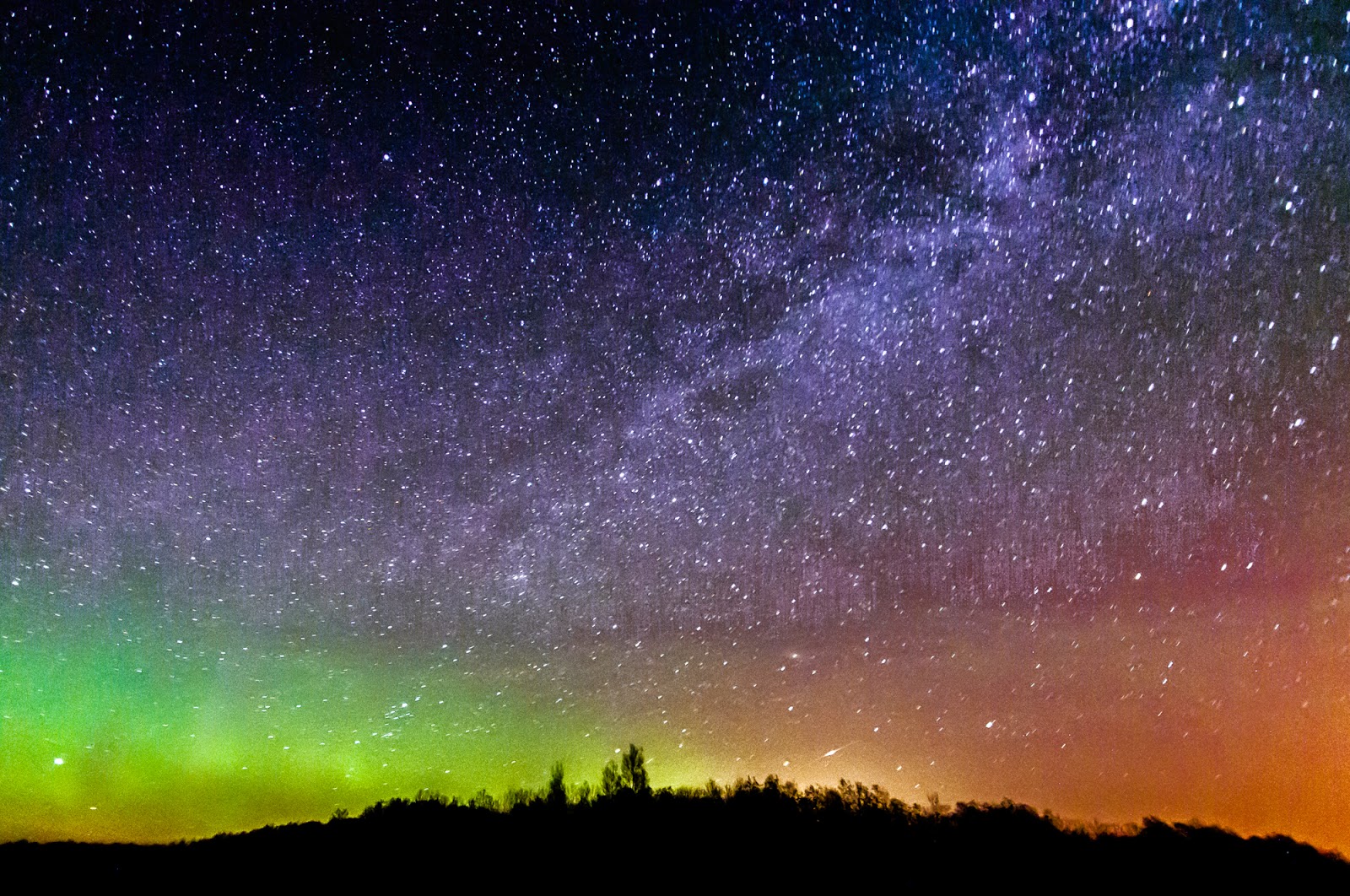
Credit: Gail Lamm
A small Camelopardalid meteor streaks through the northern lights as the Milky Way shines overhead in this stunning photo by stargazer Gail Lamm from Balmoral, Manitoba in Canada on May 24, 2014.

Credit: Malcolm Park via the Virtual Telescope Project
A brilliant meteor streaks over Toronto, Canada in this photo by Malcolm Park shared by the photographer and VirtualTelescope Project during the Camelopardalid meteor shower created by Comet 209P/LINEAR early on May 24, 2014.

Credit: BG Boyd
Photographer BG Boyd captured this photo of a meteor from the Camelopardalid meteor shower over Tucson, Arizona early on May 24, 2014. The meteor display was created by dust from Comet 209P/LINEAR.
space.com
space.com
The Night Sky

Credit: Canada-France-Hawaii Telescope/Coelum
Friday, May 30, 2014: Stars form within nebula NGC 2170, which lies in the constellation of Monoceros (The Unicorn). A dark nebula, such as this one, provides raw material for the star formation going on inside them. The newly formed, massive blue stars seen here continue to push away traces of the dust that previously hid them from view. The material that remains will eventually disperse in the interstellar medium. ~Tom Chao

Credit: ESA/Hubble & NASA; Acknowledgement: Nick Rose
Wednesday, April 16, 2014: Spiral galaxy NGC 3455 lies roughly 65 million light-years away from us in the constellation of Leo (The Lion). NGC 3455 falls into the category of type SB galaxy — a barred spiral — in the Hubble classification system, the Hubble Sequence. Galaxies of this type appear to have a bar of stars slicing through the bulge of stars in their centers. Further, this galaxy is considered a SBb type, which means its spiral arms neither wind tightly nor loosely. NGC 3455 makes up a pair of galaxies with its partner, NGC 3454 (out of frame). This cosmic duo belong to the NGC 3370 group.

The Orion Nebula, also known as Messier 42 or NGC 1976, is located approximately 1,500 light-years from Earth. Miguel Claro took the photo in Serra de Aire, Portugal near the Mira de Aire Caves complex. He used a portable Vixen Polarie Star Tracker Mount with a Canon 60Da camera and Astro Professional ED 80 telescope to capture the image, which was released to Space.com on Feb. 7, 2014.
Credit: Miguel Claro | www.miguelclaro.com

Credit: Canada-France-Hawaii Telescope/Coelum
Tuesday, April 1, 2014: These four spiral galaxies in NGC 4410 display an extraordinary cosmic spectacle, each generating immense tidal forces that rip each other apart as they pass close to each other. The galactic disks and spiral arms stretch apart while stellar filaments swirl into the intergalactic medium as the galaxies entwine in a dance of staggering proportions. ~Tom Chao

The Swan Nebula (M17), where ultraviolet radiation streaming from young hot stars sculpts a dense region of dust and gas. M17 is some 5,200 light-years from Earth in the constellation Sagittarius and is one of the most massive and luminous star-forming regions in our galaxy
Photograph: Gemini Observatory/AURA

On the left, surrounded by blue spiral arms, is spiral galaxy M81. On the right marked by red gas and dust clouds, is irregular galaxy M82. This stunning vista shows these two mammoth galaxies locked in gravitational combat, as they have been for the past billion years. The gravity from each galaxy dramatically affects the other during each hundred million-year pass. Last go-round, M82's gravity likely raised density waves rippling around M81, resulting in the richness of M81's spiral arms. But M81 left M82 with violent star forming regions and colliding gas clouds so energetic the galaxy glows in X-rays.
Credit: Rainer Zmaritsch & Alexander Gross

Robert Fields sent Space.com this image of Messier 42, or the Orion Nebula on March 18, 2014. The image is a compilation of narrowband data in SII, HA and OIII taken from Irvington Observatory of Howell Twp, Miss.
Credit: Robert Fields

The Pleiades star cluster (M45) is a group of 800 stars formed about 100 million years ago. The cluster is located 410 light-years away from Earth in the constellation Taurus.
Credit: Chuck Manges | www.astrochuck.blogspot.com

A. Garrett Evans sent Space.com this 9-shot panorama of the Milky Way rising over Cape Neddick Lighthouse in York, Maine on March 3, 2014. The photo covers nearly 180 degrees and was taken with a Canon 6D camera, Canon 16-35mm @ 16mm, ISO 4000, f/2.8, 30 sec.

Seen here is a jaw-dropping, amazing, stunning panorama that includes several of the most famous night sky objects, Orion's Belt and the surrounding molecular cloud. What could possibly be said to capture the sheer incredibleness of this image that isn't conveyed simply by looking at it?
First of all, to set the scene, we're looking at the three stars in Orion's Belt, Alnitak, Alnilam and Mintaka, seen at left in the image. Just below Alnitak is the extremely recognizable Horsehead Nebula. Over on the right of the image is the gorgeous Orion's Nebula, visible to the naked eye as the middle star in Orion's sword. Both nebulas and the surrounding gas and dust are among the hottest regions of star formation that can be seen in the night sky. All of these objects have been studied for centuries, yielding insight in modern times into the life cycles of stars.
This beautiful vista was created by Australian astrophotographer Terry Hancock. The data were captured in January, February and early March 2014 over eight nights from Hancock's home in Fremont, Michigan. Check out more of his work on his Flickr page.
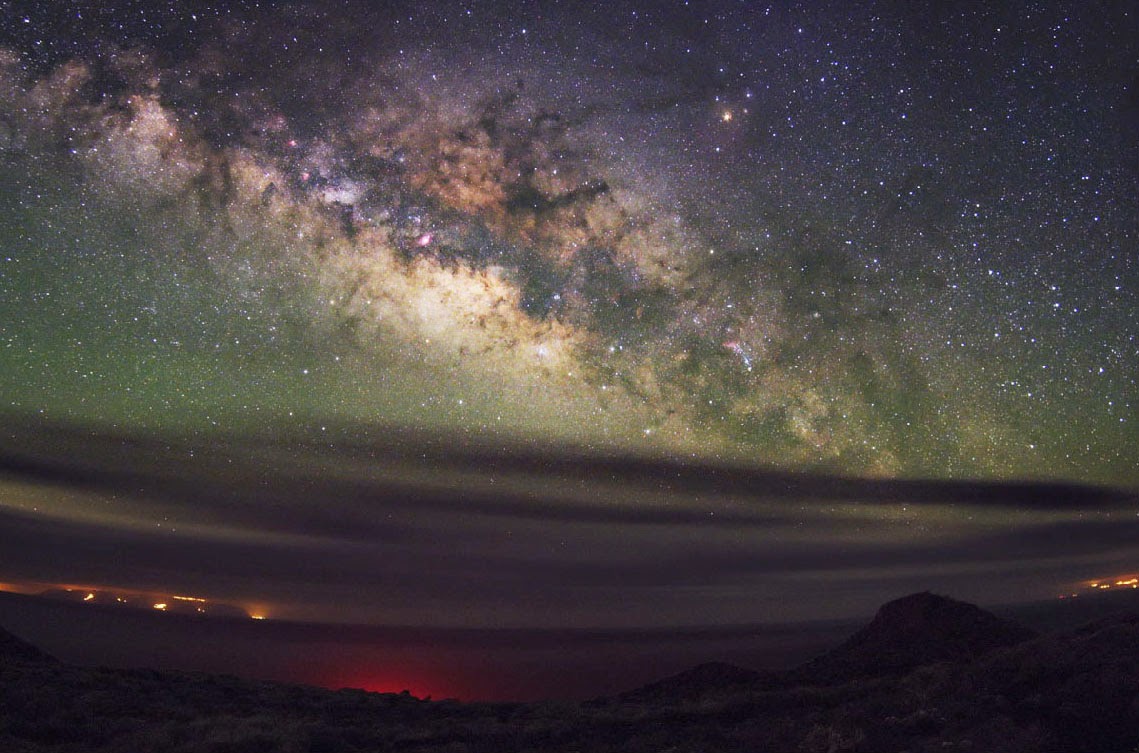
Green airglow shimmers atop translucent clouds as the Milky Way rises over a remote island off the northwest coast of Africa in a majestic photo recently sent to Space.com. Credit: project nightflight
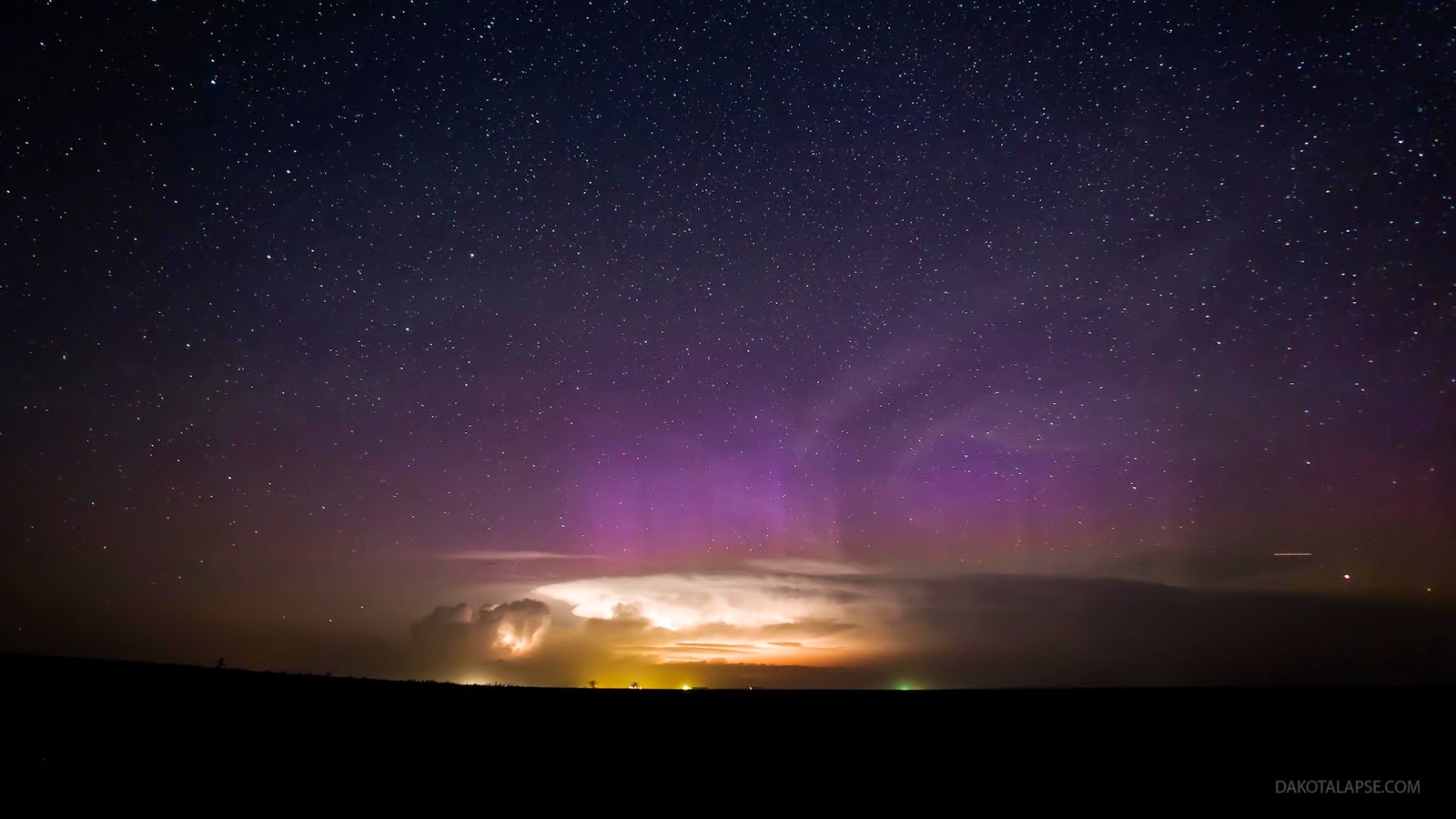
Randy Halverson dakotalapse.com captured the footage from April-Nov 2013 in South Dakota, Utah and Wyoming. 2 Canon 5D Mark III and 1 Canon 6D cameras were used to create this.

Astrophotographer Ken Crawford sent Space.com this image of galaxy NGC 2685, also known as Arp 336, on March 4, 2014. He captured the image from Rancho Del Sol Observatory in Rancho Del Sol Camino, Calif.

Astrophotographer Garry Owens sent in a photo of the recent brilliant auroral display seen in the United Kingdom. He took the shot on Feb. 27, 2014, in Prestatyn, Wales, UK.
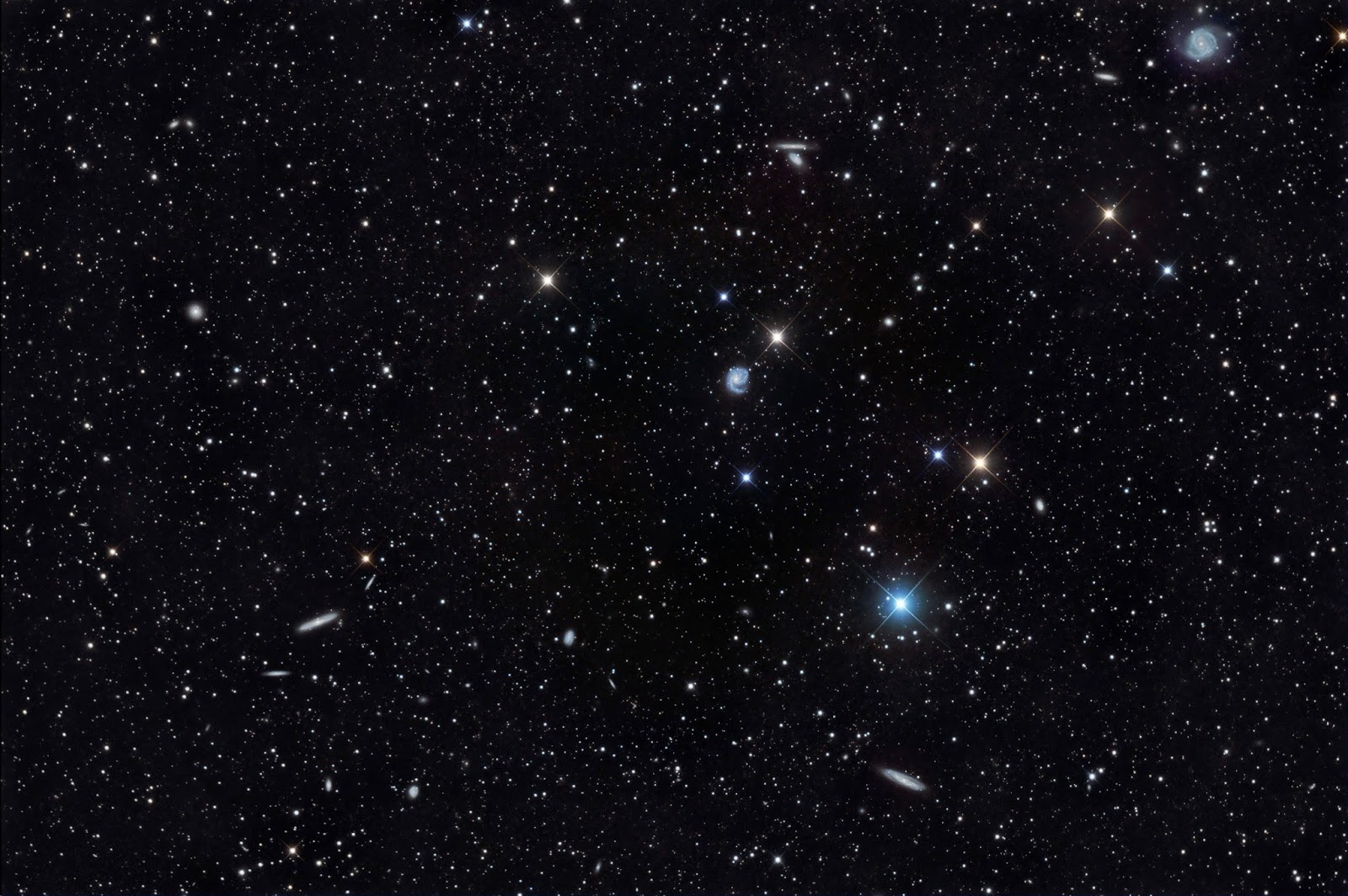
Astrophotographer Terry Hancock sent Space.com this wide field image of a few galaxies in the constellation Coma Berencies on March 2, 2014. He captured the photo from Fremont, Mich. on Feb. 22 and 27, 2014.
Comet 209P/LINEAR

Photo Credit: Jeffrey Berkes
New Meteor Shower: How to Hear the Shooting Stars
By Joe Rao, Space.com Skywatching Columnist | May 20, 2014 03:07pm ET

Comet 209P/LINEAR may create a new meteor shower on May 23-24, 2014.
Credit: NASA/JPL
Even if cloudy skies or bright city lights hamper your ability to see the much-anticipated meteor shower this weekend, you can still listen to it on the radio.
On Friday night and early Saturday morning (May 23-24), Earth will plow through debris shed over the years by Comet 209P/LINEAR. The result likely will be a new meteor shower, and possibly a spectacular meteor storm of 1,000 or so shooting stars per hour, experts say.
Under certain conditions, meteors can reflect radio waves in the same way that the ionosphere — a portion of Earth's upper atmosphere — propagates transmissions between widely separated ham-radio operators. The ionosphere usually reflects frequencies below 30 megahertz (MHz), but it's transparent to higher frequencies, such as the FM broadcast band (88 to 108 MHz).
Such high-frequency (short-wavelength) radio signals generally pass unimpeded through Earth's atmosphere in straight lines; they cannot follow the curvature of the Earth to reach a listener beyond the horizon. Yet when certain layers of the upper atmosphere become ionized, they can reflect the signals back to the ground far away. The lowest such layer, 60 to 70 miles (96 to 112 kilometers) up, is called the "E layer" of the ionosphere — and that's the altitude where the majority of meteors are seen.
So, when a meteoroid vaporizes as it passes through the atmosphere, it briefly ionizes air molecules along its path. Forming an expanding column or cylinder several miles or more in length, these ions can scatter and reflect radio waves, in much the same way that jet contrails scatter sunlight, leaving a glowing trail in the darkening sky after sunset. But because the ion trails disperse rapidly, the reflected radio waves generally last for only a few seconds.
Tiny particles tend to vaporize at the bottom of the E layer. Large particles, in contrast, begin to flame higher up. And predictions for the particles shed from Comet 209P/LINEAR suggest that most of them will be large. Such meteors produce longer-lasting ionization, and since they start to "flame on" higher up, they can reflect signals from more distant transmitters.
On the ground, a meteor's appearance is signaled by the momentary enhancement of FM reception from a distant station.
For this to work, find a frequency where no nearby FM station is broadcasting. You'll have the best chance of success by scanning the low-frequency end of the FM band, below 91.1 MHz.

Credit: NASA Marshall Space Flight Center
Why there?
The low end of the FM dial is where the lower-power stations, chiefly run by colleges and universities, are found, and they're usually free from local interference from high-power commercial stations.
In fact, unless you live in a very unpopulated region of the country, your chances of finding an open frequency free of interference above 91.1 MHz is rather small. Therefore, you should tune to a distant station on a clear frequency below 91.1 MHz.
The FM Atlas, which was published from 1970 to 2010, provided listings of all FM stations in North America, with the unique feature of frequency-by-frequency maps. Bruce Elving, publisher of the FM Atlas, was an expert in all things FM. Elving passed away in 2011, but as a tribute to his love of and dedication to FM radio, the 21st and final edition (2010) is freely available courtesy of AmericanRadioHistory.com. http://www.americanradiohistory.com/Archive-FM-Atlas/FM-Atlas-21-2010.pdf
On the same site, you can also view a complete listing of AM and FM stations from the 2010-2011 edition of the M Street Directory: http://www.americanradiohistory.com/Archive-M-Street/2010/Freq-M-Street-19-2010-2011.pdf

Credit: By Karl Tate, Infographics Artist
What are you listening for?
Normally, you will just hear a hiss of noise when you're tuned in to an "empty" radio frequency, but as meteors zip in through the atmosphere, a distant, silent station will abruptly "boom in" for anywhere from a fraction of a second to perhaps several seconds. You might also hear what initially sounds like a "pop" or whistle, and then, as the ionization trail dissipates, the station will quickly fade away.
Because of their height, meteors best reflect signals from stations 800 to 1,300 miles (1,300 to 2,100 km) from you.
The best time to listen is when the radiant — the spot from which the meteor shower appears to originate — is 45 degrees above the horizon, as seen from a point midway between you and the transmitter. (Your outstretched fist held at arm's length measures about 10 degrees.)
At the predicted peak time for Saturday morning's potential meteor outburst, the U.S. Pacific Northwest and southern Canada will see the radiant close to that preferred altitude, whereas New York, Chicago, Denver and Los Angeles will not be far behind, at about 30 degrees. [How Meteor Showers Work (Infographic)]
Also, it is best to tune to a station located in a direction that is perpendicular to the radiant. Since the 209P/LINEAR radiant will be toward the northern part of the sky, the better listening directions will be to the west and east of you. (The possible new meteor shower should appear to radiate from a point near Polaris, the North Star, which lies at the end of the handle of the Little Dipper.)

Most meteors are heard but not seen
If you are watching for meteors while monitoring your radio, most of the time, you will hear a "ping" of reception but won't see a corresponding meteor streak in the night sky.
Recall that most of the meteors you're "hearing" are roughly halfway between you and the radio station, about 400 to 650 miles (650 to 1,050 km) away, so they are occurring either near the horizon or just below it.
Back in the 1970s, members of the Nippon Meteor Society in Japan who made extensive records of radio meteors noted that only 20 to 40 percent of radio meteors were simultaneously observed visually.
What if you can't find a clear frequency?
It may be difficult to find a clear or empty FM frequency on the radio dial, especially if you live in large metropolitan or urbanized areas.
In many ways, finding a clear frequency seems to go hand in hand with trying to find a dark sky free of light pollution; you'll probably have a much better chance in rural or country locations. But if you can't find an FM frequency to work with, don't despair. You can still listen for meteors on Space Weather Radio.
Radio engineer Stan Nelson uses a Yagi antenna in New Mexico to detect 54-MHz TV signals reflected from meteor trails. When a meteor passes over his observatory — ping! — there is an echo. It's the next best thing to a giant government radar!
For more details, visit spaceweatherradio.com.
Good luck, and good listening!
Eta Aquarid Meteor Shower

Image credit: Kevin Cole
Meteor Shower Spawned by Halley's Comet Peaks This Week
By Joe Rao, Space.com
Early Tuesday morning (May 6), just before dawn begins to light up the eastern sky, stargazers have an opportunity to see a meteor shower made up of debris from one of the most famous of comets in history: Halley's Comet.
Halley's Comet made its last pass through the inner solar system in 1986 and it's not due back until the summer of 2061. Nonetheless, each time Halley sweeps around the sun, it leaves behind a dusty trail — call it "cosmic litter" — that ends up trailing behind the comet.
And as it turns out, the orbit of Halley's Comet closely approaches the Earth's orbit at two places. The first point comes now, in early May, producing the Eta Aquarid meteor shower. The other point occurs in the middle to latter part of October, producing a meteor display known as the Orionid meteor shower.
You can watch live webcasts of the Eta Aquarid meteor shower from the Slooh community telescope beginning at 9 p.m. EDT (0100 May 6 GMT)
This year, the Eta Aquarid meteor shower is predicted to peak early on Tuesday morning, May 6, but will also be visible late at Monday night (May 5). Under ideal conditions (a dark, moonless sky) up to 60 of these very swift meteors might be seen per hour. The shower appears at about one-quarter peak strength for several days before and after May 6.
If bad weather or bright city lights spoil your view, you can watch webcasts of Eta Aquarid meteor shower Monday night, courtesy of NASA and the Slooh community telescope.
This year will be a very good year to watch for them because the moon will be one day from First Quarter phase which means it will have long since set when the stars of the constellation Aquarius make their appearance in the southeast sky during the early morning hours and will provide absolutely no interference to viewing these swift streaks of light.
There is, however, a bit of a catch.
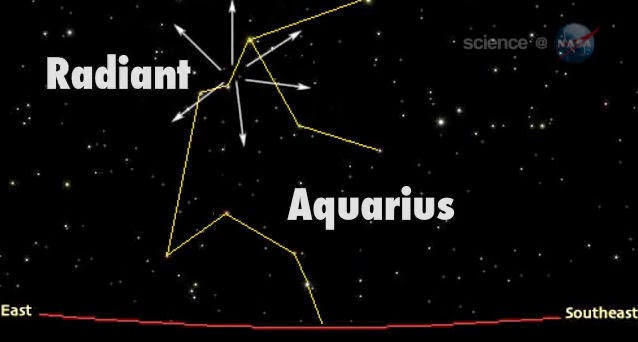
This sky map from NASA depicts the origin the Eta Aquarid meteor shower in the constellation Aquarius in the night sky. The Eta Aquarids are left over material from Halley's Comet.Pin It This sky map from NASA depicts the origin the Eta Aquarid meteor shower in the constellation Aquarius in the night sky. The Eta Aquarids are left over material from Halley's Comet.
Credit: NASA
What’s the point?From places south of the equator, the Eta Aquarids put on very good show; Australians consider them to be the best meteor display of the year. But for those watching from north of the equator, it’s a much different story.
The radiant (the origin point of these meteors) is within the "Water Jar" of the constellation Aquarius, which begins to rise above the eastern horizon around 3 a.m. your local time, but unfortunately, never really gets very high as seen from north temperate latitudes. And soon after 4 a.m., morning twilight will begin to brighten the sky.
So if you're hoping to see up to 60 meteors per hour, forget it. With the radiant so low above the horizon, the majority of those meteors will be streaking below the horizon and out of your view. In fact, from North America, typical Aquarid rates are only 10 meteors per hour at 26 degrees north latitude (for Miami, Florida, or Brownsville, Texas); five meteors per hour at 35 degrees latitude (Los Angeles, California or Cape Hatteras, N.C.); and practically zero to the north of 40 degrees latitude (New York, Chicago, and Philadelphia).
"So," you might ask, "What's the point of getting up before dawn to watch?"
The answer: You might still see something spectacular.

Astrophotographer Justin Ng of Singapore sent in a photo of an Eta Aquarid meteor taken at Mount Bromo, East Java, Indonesia, May 5, 2013.
Credit: Justin Ng
Catch an earthgrazer
For most, perhaps the best hope is perhaps catching a glimpse of a meteor emerging from the radiant that will skim the atmosphere horizontally — much like a bug skimming the side window of an automobile.
Meteor shower watchers call such shooting stars "earthgrazers." They leave colorful, long-lasting trails. "These meteors are extremely long," says Robert Lunsford, of the International Meteor Organization. "They tend to hug the horizon rather than shooting overhead where most cameras are aimed."
"Earthgrazers are rarely numerous," cautions Bill Cooke, a member of the Space Environmentsteam at the Marshall Space Flight Center. "But even if you only see a few, you're likely to remember them."
If you do catch sight of one early these next few mornings, keep in mind that you'll likely be seeing the incandescent streak produced by material which originated from the nucleus of Halley's Comet. When these tiny bits of comet collide with Earth, friction with our atmosphere raises them to white heat and produces the effect popularly referred to as "shooting stars."
So it is that the shooting stars that we have come to call the Eta Aquarids are really an encounter with the traces of a famous visitor from the depths of space and from the dawn of creation.
Editor's note: If you have an amazing picture of an Eta Aquarid meteor, or any other night sky view, that you'd like to share for a possible story or image gallery, send photos, comments and your name and location to managing editor Tariq Malik at spacephotos@space.com.
Joe Rao serves as an instructor and guest lecturer at New York's Hayden Planetarium. He writes about astronomy for Natural History magazine, the Farmer's Almanac and other publications, and he is also an on-camera meteorologist for News 12 Westchester, N.Y.Follow us @Spacedotcom, Facebook and Google+. Original article on Space.com.
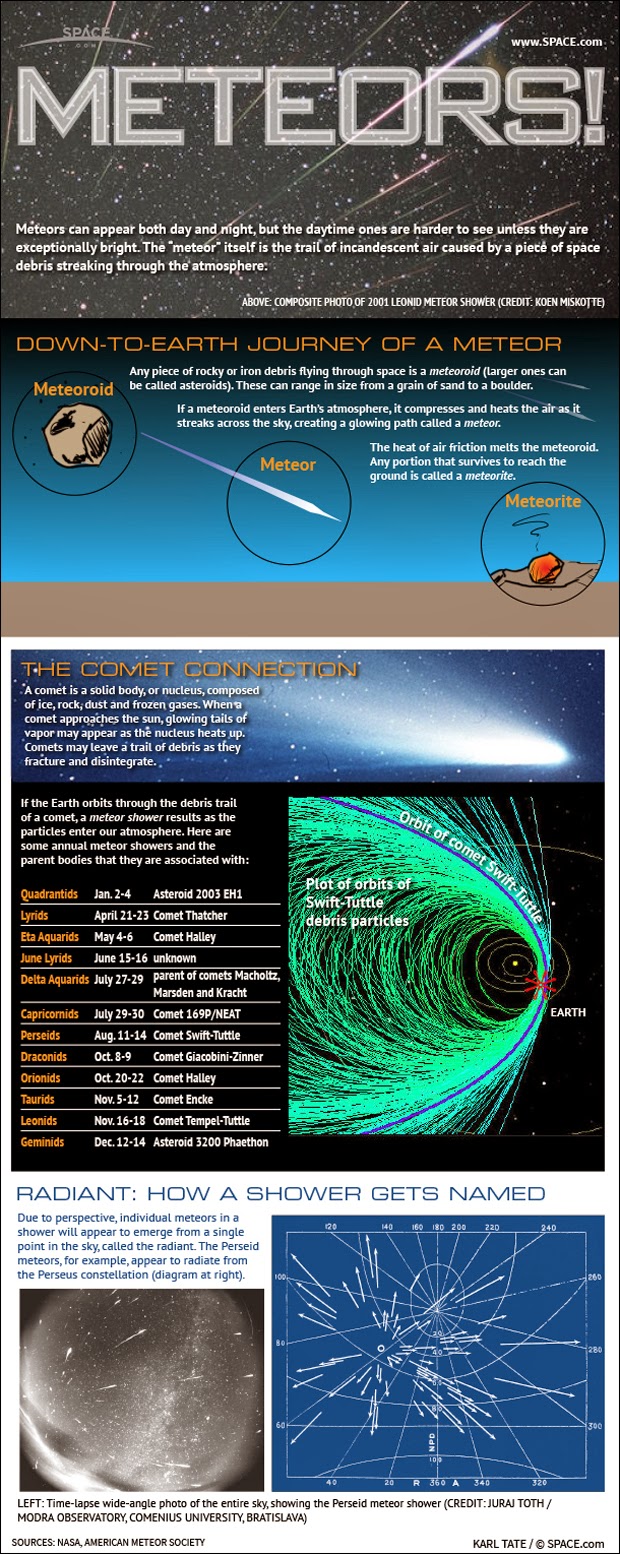
Learn why famous meteor showers like the Perseids and Leonids occur every year.Learn why famous meteor showers like the Perseids and Leonids occur every year.
Credit: Karl Tate space.com
Quantum Entanglement
Time’s Arrow Traced to Quantum Source
Natalie Wolchover, Quanta Magazine
Coffee cools, buildings crumble, eggs break and stars fizzle out in a universe that seems destined to degrade into a state of uniform drabness known as thermal equilibrium. The astronomer-philosopher Sir Arthur Eddington in 1927 cited the gradual dispersal of energy as evidence of an irreversible “arrow of time.”
But to the bafflement of generations of physicists, the arrow of time does not seem to follow from the underlying laws of physics, which work the same going forward in time as in reverse. By those laws, it seemed that if someone knew the paths of all the particles in the universe and flipped them around, energy would accumulate rather than disperse: Tepid coffee would spontaneously heat up, buildings would rise from their rubble and sunlight would slink back into the sun.
“In classical physics, we were struggling,” said Sandu Popescu, a professor of physics at the University of Bristol in the United Kingdom. “If I knew more, could I reverse the event, put together all the molecules of the egg that broke? Why am I relevant?”
Surely, he said, time’s arrow is not steered by human ignorance. And yet, since the birth of thermodynamics in the 1850s, the only known approach for calculating the spread of energy was to formulate statistical distributions of the unknown trajectories of particles, and show that, over time, the ignorance smeared things out.
Now, physicists are unmasking a more fundamental source for the arrow of time: Energy disperses and objects equilibrate, they say, because of the way elementary particles become intertwined when they interact — a strange effect called “quantum entanglement.”
“Finally, we can understand why a cup of coffee equilibrates in a room,” said Tony Short, a quantum physicist at Bristol. “Entanglement builds up between the state of the coffee cup and the state of the room.”
Popescu, Short and their colleagues Noah Linden and Andreas Winter reported the discovery in the journal Physical Review E in 2009, arguing that objects reach equilibrium, or a state of uniform energy distribution, within an infinite amount of time by becoming quantum mechanically entangled with their surroundings. Similar results by Peter Reimann of the University of Bielefeld in Germany appeared several months earlier in Physical Review Letters. Short and a collaborator strengthened the argument in 2012 by showing that entanglement causes equilibration within a finite time. And, in work that was posted on the scientific preprint site arXiv.org in February, two separate groups have taken the next step, calculating that most physical systems equilibrate rapidly, on time scales proportional to their size. “To show that it’s relevant to our actual physical world, the processes have to be happening on reasonable time scales,” Short said.
The tendency of coffee — and everything else — to reach equilibrium is “very intuitive,” said Nicolas Brunner, a quantum physicist at the University of Geneva. “But when it comes to explaining why it happens, this is the first time it has been derived on firm grounds by considering a microscopic theory.”
If the new line of research is correct, then the story of time’s arrow begins with the quantum mechanical idea that, deep down, nature is inherently uncertain. An elementary particle lacks definite physical properties and is defined only by probabilities of being in various states. For example, at a particular moment, a particle might have a 50 percent chance of spinning clockwise and a 50 percent chance of spinning counterclockwise. An experimentally tested theorem by the Northern Irish physicist John Bell says there is no “true” state of the particle; the probabilities are the only reality that can be ascribed to it.
Quantum uncertainty then gives rise to entanglement, the putative source of the arrow of time.
When two particles interact, they can no longer even be described by their own, independently evolving probabilities, called “pure states.” Instead, they become entangled components of a more complicated probability distribution that describes both particles together. It might dictate, for example, that the particles spin in opposite directions. The system as a whole is in a pure state, but the state of each individual particle is “mixed” with that of its acquaintance. The two could travel light-years apart, and the spin of each would remain correlated with that of the other, a feature Albert Einstein famously described as “spooky action at a distance.”
“Entanglement is in some sense the essence of quantum mechanics,” or the laws governing interactions on the subatomic scale, Brunner said. The phenomenon underlies quantum computing, quantum cryptography and quantum teleportation.
The idea that entanglement might explain the arrow of time first occurred to Seth Lloyd about 30 years ago, when he was a 23-year-old philosophy graduate student at Cambridge University with a Harvard physics degree. Lloyd realized that quantum uncertainty, and the way it spreads as particles become increasingly entangled, could replace human uncertainty in the old classical proofs as the true source of the arrow of time.
Using an obscure approach to quantum mechanics that treated units of information as its basic building blocks, Lloyd spent several years studying the evolution of particles in terms of shuffling 1s and 0s. He found that as the particles became increasingly entangled with one another, the information that originally described them (a “1” for clockwise spin and a “0” for counterclockwise, for example) would shift to describe the system of entangled particles as a whole. It was as though the particles gradually lost their individual autonomy and became pawns of the collective state. Eventually, the correlations contained all the information, and the individual particles contained none. At that point, Lloyd discovered, particles arrived at a state of equilibrium, and their states stopped changing, like coffee that has cooled to room temperature.
“What’s really going on is things are becoming more correlated with each other,” Lloyd recalls realizing. “The arrow of time is an arrow of increasing correlations.”
The idea, presented in his 1988 doctoral thesis, fell on deaf ears. When he submitted it to a journal, he was told that there was “no physics in this paper.” Quantum information theory “was profoundly unpopular” at the time, Lloyd said, and questions about time’s arrow “were for crackpots and Nobel laureates who have gone soft in the head.” he remembers one physicist telling him.
“I was darn close to driving a taxicab,” Lloyd said.
Advances in quantum computing have since turned quantum information theory into one of the most active branches of physics. Lloyd is now a professor at the Massachusetts Institute of Technology, recognized as one of the founders of the discipline, and his overlooked idea has resurfaced in a stronger form in the hands of the Bristol physicists. The newer proofs are more general, researchers say, and hold for virtually any quantum system.
“When Lloyd proposed the idea in his thesis, the world was not ready,” said Renato Renner, head of the Institute for Theoretical Physics at ETH Zurich. “No one understood it. Sometimes you have to have the idea at the right time.”
In 2009, the Bristol group’s proof resonated with quantum information theorists, opening up new uses for their techniques. It showed that as objects interact with their surroundings — as the particles in a cup of coffee collide with the air, for example — information about their properties “leaks out and becomes smeared over the entire environment,” Popescu explained. This local information loss causes the state of the coffee to stagnate even as the pure state of the entire room continues to evolve. Except for rare, random fluctuations, he said, “its state stops changing in time.”
Consequently, a tepid cup of coffee does not spontaneously warm up. In principle, as the pure state of the room evolves, the coffee could suddenly become unmixed from the air and enter a pure state of its own. But there are so many more mixed states than pure states available to the coffee that this practically never happens — one would have to outlive the universe to witness it. This statistical unlikelihood gives time’s arrow the appearance of irreversibility. “Essentially entanglement opens a very large space for you,” Popescu said. “It’s like you are at the park and you start next to the gate, far from equilibrium. Then you enter and you have this enormous place and you get lost in it. And you never come back to the gate.”
In the new story of the arrow of time, it is the loss of information through quantum entanglement, rather than a subjective lack of human knowledge, that drives a cup of coffee into equilibrium with the surrounding room. The room eventually equilibrates with the outside environment, and the environment drifts even more slowly toward equilibrium with the rest of the universe. The giants of 19th century thermodynamics viewed this process as a gradual dispersal of energy that increases the overall entropy, or disorder, of the universe. Today, Lloyd, Popescu and others in their field see the arrow of time differently. In their view, information becomes increasingly diffuse, but it never disappears completely. So, they assert, although entropy increases locally, the overall entropy of the universe stays constant at zero.
“The universe as a whole is in a pure state,” Lloyd said. “But individual pieces of it, because they are entangled with the rest of the universe, are in mixtures.”
One aspect of time’s arrow remains unsolved. “There is nothing in these works to say why you started at the gate,” Popescu said, referring to the park analogy. “In other words, they don’t explain why the initial state of the universe was far from equilibrium.” He said this is a question about the nature of the Big Bang.
Despite the recent progress in calculating equilibration time scales, the new approach has yet to make headway as a tool for parsing the thermodynamic properties of specific things, like coffee, glass or exotic states of matter. (Several traditional thermodynamicists reported being only vaguely aware of the new approach.) “The thing is to find the criteria for which things behave like window glass and which things behave like a cup of tea,” Renner said. “I would see the new papers as a step in this direction, but much more needs to be done.”
Some researchers expressed doubt that this abstract approach to thermodynamics will ever be up to the task of addressing the “hard nitty-gritty of how specific observables behave,” as Lloyd put it. But the conceptual advance and new mathematical formalism is already helping researchers address theoretical questions about thermodynamics, such as the fundamental limits of quantum computers and even the ultimate fate of the universe.
“We’ve been thinking more and more about what we can do with quantum machines,” said Paul Skrzypczyk of the Institute of Photonic Sciences in Barcelona. “Given that a system is not yet at equilibrium, we want to get work out of it. How much useful work can we extract? How can I intervene to do something interesting?”
Sean Carroll, a theoretical cosmologist at the California Institute of Technology, is employing the new formalism in his latest work on time’s arrow in cosmology. “I’m interested in the ultra-long-term fate of cosmological space-times,” said Carroll, author of “From Eternity to Here: The Quest for the Ultimate Theory of Time.” “That’s a situation where we don’t really know all of the relevant laws of physics, so it makes sense to think on a very abstract level, which is why I found this basic quantum-mechanical treatment useful.”
Twenty-six years after Lloyd’s big idea about time’s arrow fell flat, he is pleased to be witnessing its rise and has been applying the ideas in recent work on the black hole information paradox. “I think now the consensus would be that there is physics in this,” he said.
Not to mention a bit of philosophy.
According to the scientists, our ability to remember the past but not the future, another historically confounding manifestation of time’s arrow, can also be understood as a buildup of correlations between interacting particles. When you read a message on a piece of paper, your brain becomes correlated with it through the photons that reach your eyes. Only from that moment on will you be capable of remembering what the message says. As Lloyd put it: “The present can be defined by the process of becoming correlated with our surroundings.”
The backdrop for the steady growth of entanglement throughout the universe is, of course, time itself. The physicists stress that despite great advances in understanding how changes in time occur, they have made no progress in uncovering the nature of time itself or why it seems different (both perceptually and in the equations of quantum mechanics) than the three dimensions of space. Popescu calls this “one of the greatest unknowns in physics.”
“We can discuss the fact that an hour ago, our brains were in a state that was correlated with fewer things,” he said. “But our perception that time is flowing — that is a different matter altogether. Most probably, we will need a further revolution in physics that will tell us about that.”