
Delphinus Constellation
A Star Called 'Bob'? Dolphin Constellation's Weird Star Names Explained
By Joe Rao, Space.com | August 22, 2014 05:50pm ET
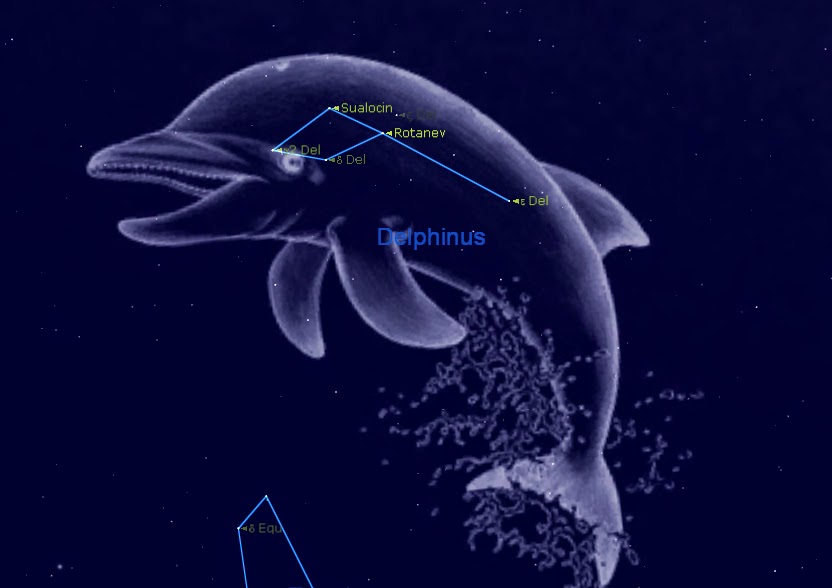
Delphinus, the Dolphin, is a sea creature constellation with some strangely named stars making up its central star pattern. The constellation is visible in the August night sky.
Credit: Starry Night software
One of the smallest constellations is reaching its highest point in the sky at around midnight local time this week, and the stars it contains have some unexpected names.
The constellation Delphinus the Dolphin attracted the attention of ancient watchers of the sky because, even though it is tiny and consists of only faint stars, the stars are so closely spaced that they are easily seen on dark, clear nights.
The star pattern looks like a small diamond with perhaps one or two stars below it. There is something especially cute about it, positioned out in the dark just east of the bright summer clouds of the Milky Way.

This sky map of the Delphinus constellation shows the location of the cosmic Dolphin in the late August sky, while looking southeast at 9 p.m. local time from mid-northern latitudes.
Credit: Starry Night software
Some reference books refer to the diamond as "Job's Coffin," though the origin of this name is unknown. Two stars in the Delphinus diamond have rather odd names: Sualocin (Alpha Delphini) and Rotanev (Beta Delphini). They first appeared in the Palermo Star Catalogue in 1814, but nobody seemed to have a clue as to their origin.
The English astronomer Thomas William Webb finally solved the mystery by reversing their letters, revealing the name of Nicolaus Venator, the Latinized form of Niccolo Cacciatore, the valued assistant and eventual successor of Palermo Observatory Director Giuseppe Piazzi. But to this day, nobody knows for sure whether it was Piazzi or Cacciatore himself who ultimately named these two stars.
And then came Derf and Bob
During the 1960s and '70s, one of the most popular people ever to lecture at New York's Hayden Planetarium was Fred Hess, who was known as the "evangelist of astronomy" and the dean of New York amateur stargazers. He was the instructor of astronomy and navigation at the Hayden Planetarium, but he was well versed in all aspects of science.
Whenever Hess gave a tour of the summer night sky, he would entertain his audiences by telling the story of Sualocin and Rotanev. Then, he would embellish the tale by stating that he was always jealous of Cacciatore and decided on his own — in tongue-in-cheek fashion — to name the two other stars in the Delphinus diamond.
For the star Gamma Delphini, he assigned the name "Derf," which is "Fred" spelled backward. And since a well-known astrophotographer in those days, Robert Little, was one of his best friends, Hess referred to the star formally known as Eta Delphini as "Bob."
Of course, the Derf and Bob monikers rarely got far beyond the confines of the Hayden Planetarium. But it was a much different story in the late 1960s when, during NASA's Apollo program, three reversed names that started out as a prank were unknowingly assigned to three stars.
The Apollo spacecraft that took men to the moon were designed to operate under inertial guidance, with gyroscopes keeping them pointed in the right direction. But because the gyroscopes tended to drift, the Apollo astronauts had to periodically recalibrate the system by using the positions of known stars.
Astronauts Virgil (Gus) Grissom, Roger Chaffee and Edward White were expected to be aboard the first Apollo flight. While training in celestial navigation however, Grissom, as a practical joke, quietly incorporated three new names onto NASA's star list: Dnoces (which was really Iota Ursae Majoris, or Talitha), Navi (Epsilon Cassiopeiae) and Regor (Gamma Velorum, or Suhail).
In later missions, these three maverick stars were accorded the same respect as celebrated ones like Sirius, Vega and Aldebaran. They even turned up on some star maps that were published during the late 1960s and 1970s.
But what did they stand for?
As it turns out, Dnoces is the word "second" spelled backward, a reference to the ordinal number often appended to White's name (Edward White II). Navi was Grissom's middle name (Ivan) spelled backward and Regor was Chaffee's first name (Roger) in reverse.
Today, the names are classified by most reference sources as "disused or never really used." Grissom had no idea that his celestial jest would turn into a memorial to himself and his crewmates. All three perished in a fire that enveloped the Apollo command module on Jan. 27, 1967.

Conflict and Social Media
Read This Before You Post About Any Conflict On Social Media
BY AVIVA SHEN, LAUREN C. WILLIAMS POSTED ON AUGUST 11, 2014 AT 11:53 AM UPDATED: AUGUST 11, 2014 AT 3:45 PM ThinkProgress
You may have noticed over the past few weeks that your Facebook news feed has morphed into a furious scroll of articles, rants, poems, and pages railing against Israel, Hamas, media bias, the Israeli Defense Forces, Bibi Netanyahu, and more. Acquaintances from high school pop up to warn you not to get sucked in by propaganda. Friends post graphic photos of dead children; other friends comment to argue they’re faked. Family members share links they swear will expose the REAL truth about what’s going on in Gaza.
Facebook is becoming increasingly important in how people get their news. A recent Pew poll found that one in three Americans get news through their Facebook feeds. And after weeks of this particular news cycle, many people are getting fed up. As anyone who has spent time on social media knows, online arguments tend to be more damaging than productive. Conveniently, Facebook makes it easy to “hide” upsetting posts without breaking off ties completely. But the ability to create a selective news feed may pose more problems for an already polarized debate. Several people on different sides of the conflict that ThinkProgress spoke to have begun muting or blocking people on Facebook over Gaza-related posts.
What exactly are people weeding out of their news feeds?
“Stuff that has more racial tones, more religious arguments,” Sarah Hagi, a 23-year-old Muslim Canadian living in the United Arab Emirates said. “Things that were too based on, Jews say this, Muslims say this. That doesn’t really help this conversation.”
“I think anything that glorifies the military or war really upsets me,” said Sarah Seltzer, a freelance writer and blogger for the Jewish Daily Forward. “I mean, you can even support the war, but to my peacenik lefty heart, it’s horrifying to see war sanctified.”
Social media is wreaking havoc on the way we perceive divisive political issues.
“Posts that make Israel out to be a genocidal machine, purposely killing as many children as possible, comparing us to the f—ing Nazis,” Adir Cohen, a musician living in Tel Aviv, told ThinkProgress. “Those posts are pure hatred and makes this whole situation just worse.”
“When I see somebody post some God-given grant to realty, I’ve silenced that,” said Chase Simon, a lawyer based in Ohio. “Usually they’re simply quoting the Old Testament or Jewish scriptures emphasizing a divine right to Palestine. That bothers me.”
“Social media has been very, very important,” Aziz Abu Sarah, a Palestinian peace advocate, blogger, and co-executive of George Mason University’s Center for World Religions, Diplomacy and Conflict Resolution says. “I don’t think I’ve seen it used as much as it has in the past month.”
Facebook enables a flood of different media sources and opposing opinions traditionally left out of established media sources.
“You’re hearing accounts from the ground from people who are experiencing it firsthand. You’re hearing the story [of Gaza] in a way I certainly can’t remember hearing before,” Timothy McCarthy, a historian and lecturer at the Harvard Kennedy School said. “I can’t remember any time in the past where the alternative representation to the mainstream media is getting airtime. Social media is wreaking havoc on the way we perceive divisive political issues.”
To narrow down the firehose of information, users have to curate their friend groups and news feeds. But finding a balance between muting upsetting posts and staying well-informed can be a challenge.
Kate Doyle, a graduate student currently in the Democratic Republic of the Congo, also differentiated between simple disagreement and extreme rhetoric. “In general, I’m fine with posts that don’t agree with my opinion — I come from a background that’s very opposite my own politics, so I have a lot of friends and family who disagree with me,” she said. “But posts that call people to action and to outrage without any room for debate will make me block someone.”
Unfriending or blocking someone is considered extreme, and very few people do it — less than 5 percent, Pew Research found. But Facebook makes the decision to avoid someone easier with the “hide” button. That little button can keep people from expanding their views or learning beyond what is comfortable.
The emotional intensity surrounding the Israeli-Palestinian conflict leaves little room for nuance. Many people told ThinkProgress they disliked the pressure to pick a side. “If you asked me if I was pro-Israel or pro-Palestine, I would disregard the premise of the question,” Tina Wexler, a medical student in Tel Aviv, said.
Also in Tel Aviv, Adir Cohen argued against the people he found offensive in his feed, but felt the arguments were casting him in a role he didn’t want to play. “I stopped posting things or answering because it threw me to a side even though I’m in the middle about a lot of things,” he said. “I had to delete Facebook from my phone.”
That lack of nuance is taking a serious toll on people’s personal relationships.
Losing Your Humanity
For Tim McCarthy, the last straw was when a close friend endorsed an article claiming Palestinians were an invented people who should instead be called “adjacent Jew-haters.”
“I responded to this post and said this breaks my heart,” McCarthy told ThinkProgress. “It’s really hard to see someone that I love and care about say things that are really hateful. And he responded that it broke his heart to see someone that he loved and cared about say things so twisted by false representations of history, that kind of thing.”
McCarthy penned a Facebook post shortly afterward, saying he was stepping back from social media because he felt he “was witnessing the worst of human nature.”
“For me, it represented my friend losing a part of his humanity,” he said, and pointed to “a larger lack of empathy that I see on every side of this issue, from lots of different kinds of people who are otherwise really thoughtful and decent people, who have gotten pulled in by the violence of this situation.”
It’s really hard to see someone that I love and care about say things that are really hateful.
His situation is unfortunately common. Incendiary Facebook posts can be surprisingly damaging to friendships. A study conducted by the University of Minnesota and Georgia Institute of Technology found that the vast majority of people, 73 percent, have disagreed with a friend online. And nearly 20 percent of them end up unfriending or blocking someone because of it, effectively ruining their relationship.
Dr. Pamela Rutledge, director of the Media Psychology Research Center, told ThinkProgress that when it comes to social media, people weed out what they don’t like much like they do in real life.
“When someone has a worldview quite different from our own, we experience the emotional discomfort of cognitive dissonance,” Rutledge said. “The only solutions are to change our opinions or stop listening.” And sometimes it’s simply easier to avoid someone than work to change your perspective.
People like feeling accepted, and tend to surround themselves with people who share common backgrounds or beliefs online and in real life, the Minnesota study found. That can create an echo chamber in which the same opinions reverberate over and over, shutting out any dissenters.
That self-sorting also means people are not used to talking through opposing viewpoints. Instead they seek reinforcement of their own beliefs.
“People who talk too much about themselves — and sharing your opinion too frequently without listening to others is the same thing — tend to not want to talk with you,” online or otherwise, Rutledge said. And since social media is all about fostering and maintaining relationships, that involves two-way exchanges.
Huma Ashraf, a graduate student in New York, finally unfriended a college friend for constantly posting strident defenses of Israel. “I almost never unfriend people on Facebook but he was just posting every hour. There was a lot of discussion in the comments and I read them because it was a lot of people I went to school with,” she said. But even though the comments were raising other points, “he just ignored it as opposed to actually engaging. He was just kind of ranting a lot.”
Ashraf was surprised to discover this side of her friend. “I hang out with him…I know him well. I didn’t expect that his views were so different — he’s a hippie!” she said. “It’s weird, I feel like I’ve had conversations with him that are on a different level.”
Most people assume that their friends will share similar views. According to the Minnesota study, most social media users believe they were at least 71 percent similar to their online friends. That assumption creates tension during politically divisive news events, when someone you thought you knew posts something offensive that’s out of sync with your personal beliefs. A Pew survey found that 58 percent of Facebook users have been surprised by a friend’s or family member’s opinion about an event in the news on the site.
These experiences caused significant struggles, from trying to rationalize the behavior of a friend to deciding whether to terminate the friendship,” the study found. The disagreements at minimum changed the way friends saw each other — some cut ties entirely.
It’s easier to cut off casual acquaintances — long lost schoolmates, people who grew up with you, or old co-workers. It’s a more complicated calculation when it comes to family or close friends.
It was more than propaganda…it was personal.
Alex Nagler, a 26-year-old New Yorker, said he was usually very vocal about political issues, but was staying quiet on Gaza in part for the sake of his family. “I’ve got a pair of very conservative older Jewish grandparents who are somewhat Facebook-savvy,” he explained. “I know this is a cop-out but sometimes it’s easier for my own sanity to not rock things there.”
Much of the delicacy of the discussion stems from those stronger ties. “Everyone knows someone connected to the conflict,” — a friend or a relative who was killed or injured, Abu Sarah said. So when online discussions went south, he said, “it was more than propaganda…it was personal.”
Israel-based musician Adir Cohen agreed — almost to the word. “I have two family members who died as soldiers — 18 and 19 years old…I have friends in [the army] protecting my ass while I’m sitting in Tel Aviv recording a record,” Cohen said. “It’s personal.”
The Problem With A Social News Feed
The amount of information circulating on social media, especially when news is constantly breaking, is shared faster than it can be authenticated. The proliferation of bad information on social media has caused the most damage, Abu Sarah explained. “There were all these videos of militants shooting rockets, titled ‘This is how kids get killed,’ ‘This is what happens in Gaza,’” which were actually from Syria or places where the people in the video aren’t speaking Arabic, he said.
“I fell for it too,” Abu Sarah added, recalling an article he posted about an Israeli soldier who was boasting about killing children. One of his followers called out the article as false, and Abu Sarah deleted it after not being able to verify whether it was true or a hoax. “If you don’t have the facts, you shouldn’t post something,” he said.
Even though they are risking friendships, many people still feel a responsibility to push back on the false information being shared on Facebook. Cohen said that he hates “comment wars,” but “could not stand the fact that so many of my uninformed friends who really don’t know what to believe were reading these same posts and potentially believing them.”
McCarthy also worried that the extreme rhetoric on his feed was keeping people from learning about the issue. “I’ve seen a deep polarization over the Israeli invasion of Gaza, and I’ve also seen a lot of people I know who don’t know what to think, who have become more and more alienated by the very polarized things that are going on on social media,” he said.
People say things on social media that they would not say to someone in person.
Recycling bad information delegitimizes any efforts to educate the public or work toward a resolution, Abu Sarah pointed out.
And being physically removed from your audience makes it easier to use inflammatory rhetoric. “People say things on social media that they would not say to someone in person. There’s a bit of throwing bombs over the fence,” Nancy Mramor, PhD, a Pittsburgh-based media and health psychologist, told ThinkProgress. “People feel protected by the sense of anonymity the Web gives – even if they’re using their real identities. There’s a feeling of safety where I can block you, and you can’t retaliate the way you want, so I can continue saying what I want.”
You can withdraw from friends online without being noticed in a way that would easily be picked up in real life through social cues, if you were to avoid eye contact or simply walk away from the argument. “With social media you obviously have the ability to ignore it once it’s gone to a place you don’t want it to go,” Nagler remarked. “You don’t have to worry about physically annoying someone to the extent of if you were talking in person.”
The result is a conversation that is more about broadcasting than about exchange. “There is no doubt in my mind that social media is transforming our politics,” McCarthy said. “One of the more negative manifestations of this transformation is we are all able to have an opinion, and express, and assert our opinion in seconds — not minutes or hours or days. There’s no process anymore in our political culture.”
Refusing To Be Enemies
Adding the snap judgment impulses of social media to the powder keg of the Israeli-Palestinian conflict seems like it could be disastrous. Yet Facebook is also bringing opposing sides together and broadening social circles that are more limited offline.
“I don’t know anybody that I actually hang out with that supports Israel — in what’s going on right now at least,” Ashraf said. “It’s a larger variety of people that I’m friends with on Facebook than I am in my life.”
In the sea of vitriol and blame, a number of Facebook groups have popped up in the past few weeks aimed at bridging the divide. Wexler pointed to Israel Loves Palestine and Palestine Loves Israel as two online communities that have given her hope. “They have been posting every day reminding each other, hey, Palestinians in Gaza don’t hate you. Hey, Israelis don’t hate you. We’re all sad that this is happening,” Wexler said.
Another Facebook group, Jews and Arabs Refuse To Be Enemies, shares pictures and statements from friends, couples, and families who bridge the divide. The group has more than 60,000 followers.
Sarah Hagi said she actually felt more empowered after finding a community online. “From the last time this war happened in 2012, I’ve been more connected with people who are really educated about the issue,” she said. “Before I was kind of scared. I was thinking, I’m Muslim, if I post, people will think I’m Hamas. But I’ve been following Jewish people, from Jewish Voices for Peace, Jewish journalists, different pages from Jewish groups. I’m following more people.”
Similarly, Sarah Seltzer and Abu Sarah credited social media with giving progressive Jews and Palestinians a voice which to speak out against the war.
Seltzer said she felt less alone in protesting the war because of “a critical mass of Jews speaking out. Many of her peers, she said, have started feeling more comfortable voicing their feelings because of “social media, and seeing the images from Gaza.”
Abu Sarah pointed out that traditionally, Palestinians have felt underrepresented in the media. In this context, “social media became important, because it’s the only place where they can tell their story,” he said.
Abu Sarah has made new Israeli friends who recruit him to join in their debates and give a Palestinian perspective that they wouldn’t have heard otherwise. Even when both sides think, “I’m probably not going to believe anything you say, but I still want to hear it,” it’s a learning experience, he said.
Even while muting posts that upset them, many people told ThinkProgress it was important for them to maintain a dialogue with people who disagreed with them.
“One of the reasons I don’t use the defriending option or the unfollowing option routinely or regularly is because I want my wall, I want my group of friends to be able to weigh in and disagree with me and disagree with one another,” McCarthy said.
Cohen agreed. “The people who are truly my friends I would never delete or stop following,” he said. “Those people I have always discussed the issue with and we have always respected each other and loved each other regardless.”
The Challenge to Embrace an Omnicultural Perspective Among Polarized Social Groups
By DAVID MYERS July 06, 2014
More than a decade after the Iraq war began, it still boggles our minds: Sunni and Shia—both revering the Quran, following Muhammad and praying to Allah—killing one another. It brings to mind the 3,500-plus dead from the clashes between Northern Ireland’s Protestants and Catholics—all, at least nominally, following the same Prince of Peace.
One wonders: Why such animosity among those so ethnically and religiously similar? Certainly, Sunni-Shia violence has deep historical-political roots. Ditto the Protestant-Catholic clashes. As the late Ed Cairns, leader of the University of Ulster’s Peace and Conflict Research Group, once explained to me, religious labels can sometimes be markers for just those kinds of deep cultural divisions. “If anything, the more [Northern Irelanders] believed or went to church, the less prejudice they showed,” he said.
But another factor—perhaps as fundamental, though less often explored—is at work and can help explain why seemingly marginal differences can seem so stark: group psychology. To better understand the puzzling intensity of clashes among kindred folk, consider four principles derived from psychological research on group identities.
1) No matter our similarities with others, our attention focuses on differences.
In the 1970s when the Yale psychologist William McGuire invited children to “tell us about yourself,” they zeroed in on their distinctiveness. Those who were foreign-born often mentioned their birthplaces. Redheads volunteered their hair color. Minority children mentioned their race. “If I am a Black woman in a group of White women, I tend to think of myself as a Black,” McGuire and his colleagues observed. “If I move to a group of Black men, my blackness loses salience and I become more conscious of being a woman.” Straight folks sometimes wonder why gay folks are so conscious of their sexual identity, though in a predominantly gay culture the sexual identity self-consciousness would be reversed.
So when people of two subcultures are nearly identical, they often overlook their kinship and become laser-focused on their small differences. Freud recognized this phenomenon: “Of two neighboring towns, each is the other’s most jealous rival; every little canton looks down upon the others with contempt. Closely related races keep one another at arm’s length; the South German cannot endure the North German, the Englishman casts every kind of aspersion upon the Scot, the Spaniard despises the Portuguese.”
2) We naturally divide our worlds into “us” and “them,” ingroup and outgroup.
We inherited our Stone Age ancestors’ need to belong, to live in groups. There was safety in solidarity. Whether hunting, defending or attacking, 10 hands were better than two. Like them, we form social identities.
But the benefits come at a cost. Mentally drawing a circle that defines “us” also defines “them.” Moreover, an “ingroup bias”—a preference for one’s own community—soon follows. In experiments,even those in arbitrarily created groups tend to favor their own group. In studies by Henri Tajfel, Michael Billig and others,people grouped together by something as random as a coin toss or the last digit of their driver’s licenses felt a twinge of kinship with their number-mates, and favored their own group when dividing rewards.
3) Discussion among those of like mind often produces “group polarization.”
In one of my own early experiments, George Bishop and I discovered that when highly prejudiced students discussed racial issues, they became more prejudiced. When less prejudiced students talked among themselves, they became even more accepting. In other words, ideological separation plus conversation equaled greater polarization between the two groups.
So it goes in real life too. Analysis of terrorist organizations, for instance, has revealed that the terrorist mentality does not erupt suddenly, on a whim. It begins slowly, among people who share a grievance. As they interact in isolation, their views grow more and more extreme.
By connecting like-minded people, the Internet’s virtual groups often harness group polarization for good purposes, as when connecting and strengthening fellow peacemakers, cancer survivors and rights advocates. But the Internet echo chamber also enables climate-change skeptics and conspiracy theorists to amplify their shared ideas and suspicions. White supremacists become more racist. Militia members become more hostile. For good or ill, socially networked birds of a feather gain support for their shared beliefs, suspicions and inclinations.
4) Group solidarity soars when facing a common enemy.
From laboratory experiments to America immediately after the Sept. 11 attacks, shared threats foster unity. During conflict, we-feeling rises. During wars, patriotism surges.
In one of psychology’s famous experiments, the psychologist Muzafer Sherif, in 1954, randomly split Oklahoma City boy campers into two groups for a series of competitive activities, with prizes for the victors. Over the ensuing two weeks, ingroup pride and outgroup hostility increased—marked by food wars, fistfights and ransacked cabins. Intergroup contacts yielded more threats—and stronger feelings of ingroup unity—until Sherif engaged the boys in cooperative efforts toward shared goals, such as moving a stuck truck or restoring the camp water supply.
In more playful ways, these group dynamics also fuel sports rivalries. Think Yankees–Red Sox, March Madness and World Cup soccer. For an ardent Cubs fan, it’s a good day if the Cubs win—or the White Sox lose. Here in West Michigan, America’s biggest small-college sports rivalry plays out whenever my school, Hope College, plays Calvin College, pitting the Dutch-heritage Reformed Church in America tradition against the Dutch-heritage Christian Reformed Church tradition—extending the two churches’ 1857 split over what now seem like minor matters. It’s all in good fun, an intense competition with no fundamental hate.
But when the social dynamics are writ large, people will not only cheer for their groups—they may also kill and die for them. Turning today’s closed fists into tomorrow’s open arms requires recognizing the relative modesty of our differences, finding our deeper commonalities, defining a larger “us,” communicating across group lines and discovering transcendent goals.
Such conflict resolution is most needed, yet most difficult, in times of crisis. When conflicts intensify, images become more stereotyped, judgments more rigid, communication more difficult. Both sides are prone to threaten, coerce or retaliate.
The challenge is for cultures to discover what social psychologist Fathali Moghaddam calls an “omnicultural” perspective that both recognizes commonalities and respects differences. From Iraq to Northern Ireland, the Koreas to the Sudans, this is the great challenge in times of conflict—to embrace “diversity within unity.” E pluribus unum.